Korea’s Multi-Depth Skin Treatment Technology
Korean beauty has already transformed the global skincare industry. Now, its influence is moving beyond serums, essences and “glass skin” routines and into medical aesthetics. A new treatment protocol called TitaniumLift™ is bringing a Korean multi-depth approach to skin quality to aesthetic practices across North America, highlighting how Korean aesthetic concepts are increasingly influencing treatment development outside South Korea. Alma North America announced the launch on August 13, 2026. The development comes at a time when consumers are increasingly interested in skin quality, preventative aesthetics, non-invasive treatments and natural-looking results rather than dramatic cosmetic changes. For RAMP Studio, the story represents a larger trend: K-Beauty is evolving from a skincare phenomenon into a global influence on aesthetic treatment technology.
What Is the New Multi-Depth Skin Treatment?
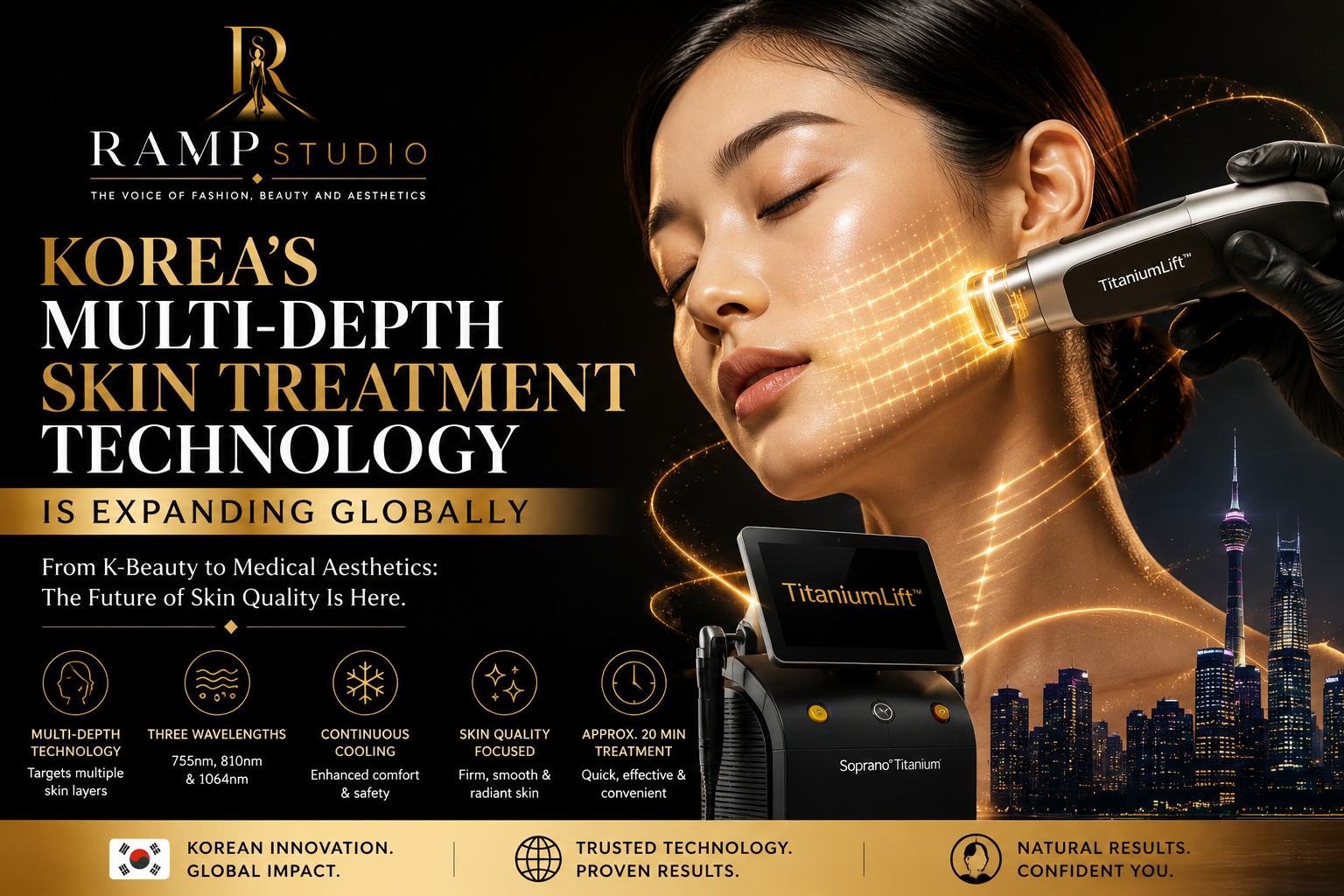
TitaniumLift is described by Alma North America as a treatment protocol originating in Korea and available on the company’s Soprano Titanium platform.According to the company’s announcement, the protocol combines three wavelengths—755 nm, 810 nm and 1064 nm—with simultaneous energy delivery and continuous contact cooling. The concept is to deliver thermal energy at multiple dermal depths rather than focusing on just one layer of the skin. Alma says the protocol is designed around skin quality and ongoing maintenance, with a treatment time of approximately 20 minutes. It is important to note that these are manufacturer-described features and claims. Individual results can vary, and consumers should discuss suitability and expected outcomes with a qualified medical professional.
Why Is Korean Aesthetic Technology Getting Global Attention?
Korea has become one of the world’s most influential beauty markets. The country’s influence began with skincare routines and cosmetic products, but the underlying philosophy has increasingly shaped conversations around prevention, skin health, consistency and natural-looking results. Grand View Research estimates that the global K-Beauty products market could reach approximately $129.2 billion in 2026, rising to about $252.4 billion by 2033. Its research also identifies skin health, hydration and preventive skincare as important drivers of the category. That cultural influence is now intersecting with medical aesthetics. Instead of simply asking how to correct visible aging, consumers are increasingly interested in maintaining the appearance and quality of their skin over time.
From “Glass Skin” to Skin Quality
One of the defining ideas behind K-Beauty has been the pursuit of healthy-looking, hydrated and luminous skin. The current aesthetic conversation takes that philosophy one step further. Rather than relying solely on makeup to create a smoother appearance, consumers are increasingly exploring professional treatments designed to improve the appearance of skin texture, firmness and overall quality. This doesn’t mean every Korean aesthetic treatment is identical or that every procedure is scientifically proven to deliver the same results. Instead, the bigger trend is the shift in consumer expectations. People increasingly want skin that looks naturally healthy rather than heavily altered.
How Does TitaniumLift Work?
According to Alma North America’s announcement, TitaniumLift combines three laser wavelengths:
- 755 nm
- 810 nm
- 1064 nm
The company says these wavelengths are delivered simultaneously across multiple dermal depths, alongside Continuous Contact Cooling™ intended to improve treatment comfort. The protocol is positioned around a multi-depth approach, meaning the treatment isn’t designed around a single skin layer. This is an important concept in modern aesthetics because skin aging is not limited to one level of tissue. However, readers should distinguish between the technology’s proposed mechanism and proven clinical outcomes. A treatment being technologically sophisticated does not automatically mean it is appropriate for everyone or superior to every alternative.
Why Non-Invasive Treatments Are Becoming More Popular
The growth of non-invasive aesthetics is closely connected to changing consumer expectations.
Many patients want treatments that fit around busy lifestyles.
That means factors such as:
- Short treatment times
- Minimal disruption
- Comfort
- Natural-looking outcomes
- Maintenance-focused treatment plans
can influence treatment decisions.
Alma describes TitaniumLift as approximately a 20-minute protocol and says it is designed around patient comfort.
These characteristics help explain why non-invasive skin-quality treatments are attracting attention.
The Shift From Dramatic Transformation to Maintenance
One of the biggest trends in modern aesthetics is the move away from dramatic transformations.
Consumers increasingly want to look refreshed rather than obviously treated. This is also consistent with the broader regenerative-aesthetics movement, where the focus is often on skin quality, collagen support and gradual maintenance. The multi-depth concept fits naturally into that conversation. Instead of waiting until visible changes become significant, some consumers are interested in incorporating professional treatments into longer-term skincare and maintenance strategies. That doesn’t mean everyone needs aesthetic procedures. Good skincare, sun protection and healthy lifestyle habits remain fundamental.
K-Beauty Is Becoming More Technology-Driven
K-Beauty is often associated with products such as:
- Essences
- Sheet masks
- Serums
- Sunscreens
- Barrier-supporting moisturizers
- Gentle active ingredients
But the next stage of Korean beauty’s global influence could be increasingly technology-focused. The emergence of Korean-inspired aesthetic protocols demonstrates how beauty culture, medical technology and consumer expectations are beginning to overlap. The market data also supports the broader global influence of Korean beauty. Grand View Research says the K-Beauty market is being supported by Korean pop culture, social media, product innovation and demand for skin-health-focused solutions.
Why Multi-Depth Treatment Is Interesting
The skin isn’t a single uniform structure.
Different depths contain different tissues and structures, which is why aesthetic technologies can use different wavelengths, energy levels and treatment techniques. The appeal of a multi-depth protocol is therefore relatively straightforward:
Instead of concentrating treatment on one level, it aims to address multiple depths within a single protocol.
For consumers, however, the important question shouldn’t simply be whether a treatment is “multi-depth.”
They should ask:
- What technology is being used?
- What is the treatment intended to address?
- What evidence supports the specific protocol?
- Is it suitable for my skin type?
- What are the risks?
- How many treatments are recommended?
- What results are realistic?
Is TitaniumLift Available Globally?
The latest announcement confirms expansion into North America, rather than worldwide availability. Alma North America announced on August 13, 2026, that TitaniumLift would be introduced to aesthetic practices across North America. Availability in other countries will depend on local clinics, regulations, device approvals and market rollout. So while the influence of Korean aesthetic technology is global, consumers should not assume that every Korean-origin protocol is immediately available or approved in every country.
Who Might Be Interested in Multi-Depth Skin Treatments?
People exploring non-invasive aesthetic options may be interested in treatments that target concerns such as:
- Early signs of skin aging
- Reduced firmness
- Dull-looking skin
- Skin-quality concerns
- Desire for preventative maintenance
- Preference for non-surgical options
However, suitability must be determined individually.
Skin type, age, medical history, medications, existing conditions and previous treatments can all influence whether a particular procedure is appropriate.
What Makes the Korean Approach Different?
The biggest difference may not be a single machine or ingredient. It is the philosophy behind the treatment.
Korean beauty culture has traditionally placed strong emphasis on:
Consistency → Prevention → Skin quality → Long-term maintenance
That philosophy contrasts with a purely corrective approach in which people wait for visible aging and then seek a dramatic intervention.
Modern aesthetics is increasingly exploring the middle ground.
Rather than waiting for major changes, some consumers prefer smaller, ongoing interventions designed to maintain a healthy-looking appearance.
Could This Be the Next Major K-Beauty Export?
Korean skincare has already become a global phenomenon.
Now, Korean aesthetic concepts may be following a similar path.
Grand View Research forecasts the global K-Beauty products market to grow at approximately 10% annually between 2026 and 2033, reflecting continued international demand.
While product sales and medical-aesthetic technology are different markets, the growth of K-Beauty demonstrates the strength of Korean influence on global beauty preferences.
The next phase could involve Korean-inspired:
- Treatment protocols
- Skin-analysis technologies
- Energy-based devices
- Preventative aesthetic approaches
- Personalized treatment plans
What Consumers Should Know Before Treatment
The popularity of a treatment should never be the only reason to try it.
Anyone considering an aesthetic procedure should consult a properly qualified medical professional and ask about the device, treatment protocol, expected results, contraindications and potential side effects.
It is also important to understand that a treatment described as “Korean,” “advanced” or “multi-depth” isn’t automatically better for every person.
A good treatment plan should be based on individual needs rather than a social-media trend.
The Bigger 2026 Aesthetic Trend
The TitaniumLift announcement reflects a broader movement happening across the aesthetics industry.
The conversation is increasingly moving toward:
Skin quality instead of simply volume
Maintenance instead of dramatic correction
Non-invasive procedures instead of surgery when appropriate
Personalized protocols instead of one-size-fits-all treatments
Natural-looking results instead of obvious transformation
This is why Korean aesthetic technology is attracting attention beyond South Korea.
Frequently Asked Questions
What is Korea’s multi-depth skin treatment technology?
It refers to treatment approaches designed to deliver energy at multiple depths of the skin. TitaniumLift is a newly announced example of a Korean-origin protocol that combines three wavelengths on the Soprano Titanium platform.
What is TitaniumLift?
TitaniumLift is a treatment protocol announced by Alma North America in August 2026. The company describes it as a Korean-origin multi-depth skin-quality protocol using 755 nm, 810 nm and 1064 nm wavelengths with cooling technology.
Is TitaniumLift a surgical procedure?
The protocol is described as a non-surgical, energy-based aesthetic treatment. However, consumers should consult a qualified practitioner to understand the specific procedure and whether it is appropriate for them.
How long does TitaniumLift take?
Alma North America describes the protocol as approximately 20 minutes.
Does multi-depth treatment mean better results?
Not necessarily. Multi-depth technology is a treatment approach, not a guarantee of superior results. Outcomes depend on the technology, protocol, patient and practitioner.
Is Korean aesthetic technology becoming popular internationally?
Yes. Korean beauty has significant international influence, and current developments such as TitaniumLift’s North American launch show that Korean-inspired aesthetic approaches are expanding beyond skincare products.
Is TitaniumLift available everywhere?
No. The latest announcement specifically concerns expansion across North America. Availability depends on local regulations, providers and market rollout.
Is this treatment suitable for all skin types?
Alma states that the TitaniumLift protocol is designed for Fitzpatrick skin types I–VI. Individual suitability should still be assessed by a qualified professional.
How does this fit into the K-Beauty trend?
It represents a shift from Korean beauty being primarily associated with skincare products toward broader influence in aesthetic treatment concepts and technologies.
Final Thoughts
Korea’s influence on beauty is entering a new phase.
The global K-Beauty movement began with skincare routines, innovative formulations and the pursuit of healthy-looking skin. Now, Korean approaches are increasingly influencing the world of professional aesthetics.
The introduction of TitaniumLift in North America is a timely example of that transition, bringing a Korean-origin multi-depth skin-quality protocol to a new market.
But the bigger story is not simply one new treatment.
It is the growing demand for non-invasive, personalized and maintenance-focused aesthetics.
As beauty consumers continue moving toward natural-looking results and long-term skin health, Korean aesthetic innovation could become an increasingly important influence on the future of global medical aesthetics.
Sources
- Alma North America / PR Newswire — TitaniumLift announcement
- Grand View Research — K-Beauty Products Market 2026–2033
- Grand View Research — K-Beauty Market Growth Report
- Morningstar — TitaniumLift announcement
Views: 5