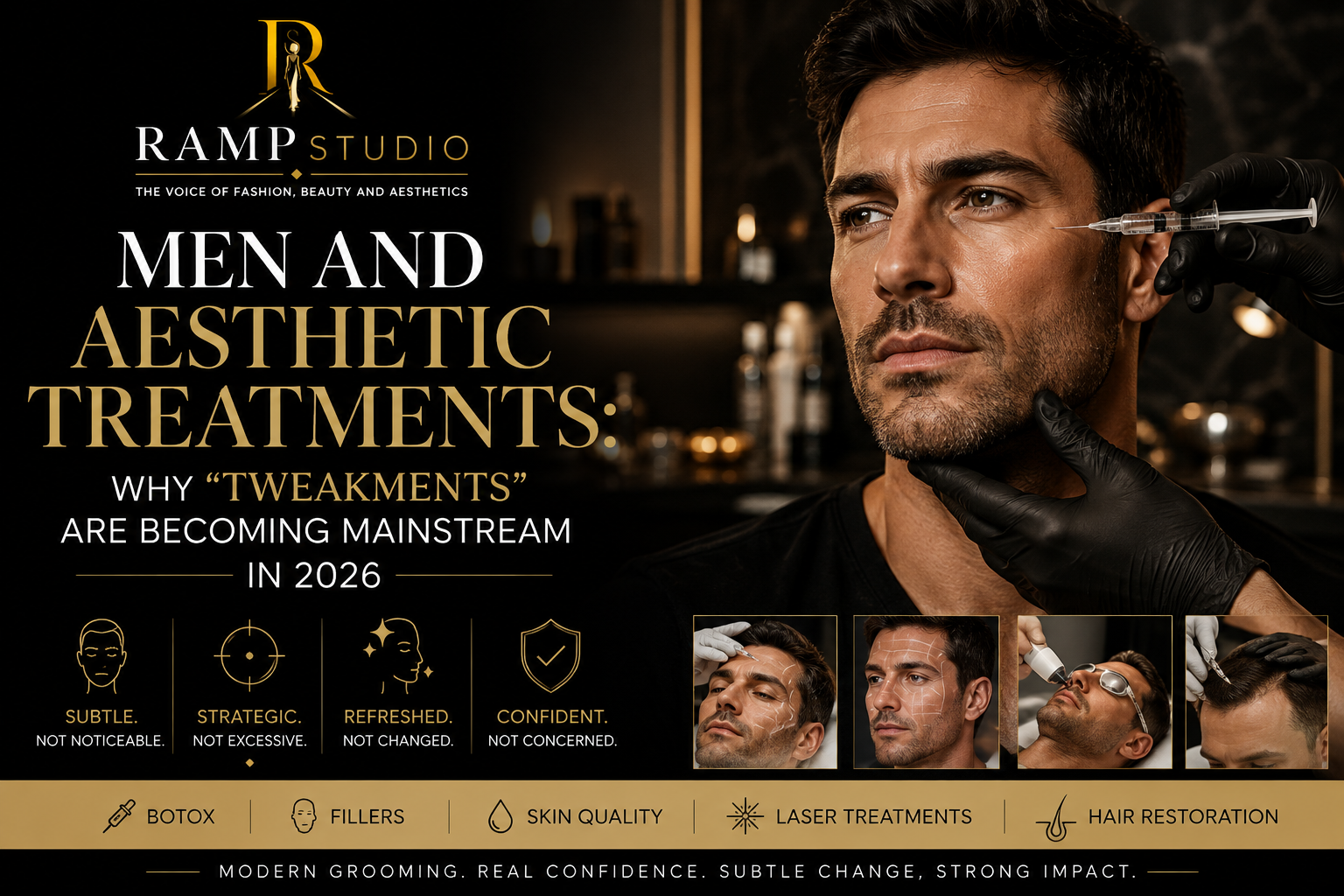
For years, cosmetic treatments were often marketed primarily toward women. In 2026, that picture is changing. More men are openly considering Botox, dermal fillers, laser treatments, skin-quality procedures and other non-surgical aesthetic treatments—often with one important goal: to look fresher without looking obviously “treated.” This growing interest has helped popularize the term “tweakments,” referring to relatively subtle aesthetic procedures designed to make small, targeted improvements rather than create a dramatic transformation. Recent reporting from The Times found that some aesthetic clinics are seeing men account for 30–40% of their patients, particularly among professionals seeking subtle improvements in tired-looking or aged features. Meanwhile, Vogue has reported on the broader normalization of aesthetic procedures among male patients, including Botox, fillers and surgical treatments. For RAMP Studio, the bigger story isn’t simply that more men are getting Botox. It’s that male aesthetics is becoming part of mainstream grooming and self-care culture.
What Are “Tweakments”?
“Tweakment” is an informal term for a relatively small cosmetic intervention intended to subtly refresh or enhance someone’s appearance. Unlike a dramatic makeover, the philosophy is often:
“Look like yourself—just more refreshed.”
Depending on the individual’s goals, tweakments can include treatments such as:
- Botulinum toxin injections
- Dermal fillers
- Skin-quality treatments
- Laser and light-based procedures
- Chemical peels
- Microneedling
- Certain regenerative or biostimulatory treatments
- Professional skincare
- Hair-restoration procedures
The appropriate treatment depends on the individual’s anatomy, skin condition, medical history and goals.
The trend is therefore less about a particular procedure and more about a style of aesthetic treatment: subtle, targeted and personalized.
Why Are More Men Considering Aesthetic Treatments?
Several cultural changes are helping normalize aesthetic procedures among men.
1. Grooming Has Expanded
Men’s grooming has moved well beyond haircuts and shaving.
Skincare, facials, professional treatments and cosmetic procedures are increasingly being discussed as part of personal presentation.
Aesthetic medicine is becoming another option within that broader grooming landscape.
2. Professional Appearance Matters
Modern workplaces are increasingly visual.
Video meetings, professional social media profiles and constant digital communication mean people often see themselves on camera throughout the day.
Recent reporting in The Times describes professionals seeking subtle treatments to look less tired and more confident, particularly in competitive industries.
3. Social Media Has Changed Beauty Standards
Men are exposed to aesthetic ideals just as women are.
Jawlines, skin quality, facial symmetry, hairlines and overall facial definition are frequently discussed across social platforms. This has contributed to greater awareness of aesthetic options—but it can also create unrealistic expectations.
4. The Stigma Is Declining
Perhaps the biggest change is cultural. A man getting Botox is no longer necessarily treated as unusual. Terms such as “Brotox” have entered mainstream media, while celebrities, athletes, entrepreneurs and professionals have helped make aesthetic treatments more visible.
Botox Is Moving Beyond the “Brotox” Joke
Botulinum toxin remains one of the most recognizable aesthetic treatments.
It works by temporarily reducing muscle activity in targeted areas. BOTOX Cosmetic, for example, is approved in the United States for certain facial lines and other cosmetic indications.
For men, treatment goals may include softening the appearance of:
- Forehead lines
- Frown lines between the eyebrows
- Crow’s feet
- Certain neck bands
The key issue is dosage and treatment planning.
Male facial anatomy can differ from female facial anatomy, and an aesthetic treatment should be planned accordingly rather than following a one-size-fits-all approach.
The modern goal is increasingly facial movement and identity preservation, rather than creating an expressionless appearance.
Dermal Fillers Are Also Becoming More Mainstream
Dermal fillers can be used to restore or add volume in specific areas.
For some male patients, treatment may focus on facial structure rather than creating the fuller features traditionally associated with cosmetic enhancement.
Depending on the individual, discussions can involve areas such as:
- Chin
- Jawline
- Cheeks
- Temples
- Under-eye area
But fillers are medical procedures, not simply beauty products.
The U.S. FDA advises consumers to choose a licensed healthcare provider with appropriate experience and specifically warns against self-injection or treatment by unqualified providers.
This is particularly important as demand increases.
The “Invisible Upgrade” Is the New Goal
One of the strongest themes in male aesthetics is subtlety.
Many men don’t necessarily want friends or colleagues to ask:
“What did you have done?”
Instead, the desired reaction may be:
“You look well.”
That difference is important.
The modern male aesthetic patient may be looking for improvements that remain difficult to identify individually—such as appearing more rested, improving skin texture or maintaining facial definition.
Recent reporting on male tweakments describes this preference for natural-looking rather than dramatic outcomes.
Skin Quality Is Becoming More Important
Another important development is the move from purely structural treatments toward skin health and quality.
Men are increasingly exploring treatments intended to improve the appearance of:
- Uneven texture
- Fine lines
- Sun damage
- Acne scarring
- Dullness
- Enlarged pores
- Overall skin appearance
This fits into the wider 2026 aesthetics movement toward regenerative and skin-quality treatments.
Polynucleotides, biostimulators, PRP and other emerging treatments are being discussed heavily across the aesthetics industry, although evidence and regulatory status vary significantly between products and procedures.
Hair Restoration Remains a Major Part of Male Aesthetics
Facial treatments are only one part of the story.
Hair loss has long been a major concern among men, and advances in hair-restoration techniques have expanded the options available.
Depending on the cause and severity of hair loss, treatment discussions may include:
- Hair-transplant surgery
- Medical hair-loss treatments
- Scalp-focused procedures
- Microneedling
- Platelet-rich plasma in selected settings
For many men, improving hair density can have a significant impact on perceived age and confidence.
Jawline Definition Is Still Popular
A defined jawline has become an especially prominent male beauty ideal on social media. This has increased interest in treatments and procedures designed to enhance or define the lower face. However, jawline enhancement isn’t appropriate for everyone. Facial proportions, bone structure, skin laxity and existing volume all affect the result. A responsible consultation should therefore focus on facial harmony, rather than simply trying to reproduce a social-media trend.
Why Natural Results Are Winning in 2026
A broader shift is taking place across aesthetic medicine: patients increasingly want personalization rather than celebrity imitation. Recent 2026 facial-plastic-surgery coverage highlights a stronger emphasis on natural results and enhancing individual features rather than dramatically changing someone’s appearance. For male patients, this can be particularly relevant. The objective isn’t necessarily to look younger by 20 years. Instead, it might be:
“I want to look like the best version of myself.”
That philosophy fits perfectly with the idea of tweakments.
Men Are Becoming More Comfortable Talking About Aesthetics
The language surrounding men’s beauty is changing.
Instead of hiding every treatment, some men are increasingly comfortable discussing:
- Skincare
- Botox
- Hair restoration
- Laser treatments
- Fillers
- Facials
- Body contouring
This doesn’t mean every man wants cosmetic treatment. It simply means the conversation is becoming less taboo. The growing male market also reflects a broader normalization of aesthetic medicine globally. The International Society of Aesthetic Plastic Surgery reported nearly 38 million surgical and non-surgical aesthetic procedures worldwide in 2024, with total procedure volume up substantially compared with 2020.
Are Men Getting the Same Treatments as Women?
Sometimes—but treatment goals can differ.
For example, a man may want to maintain stronger facial definition rather than create a softer contour. Similarly, practitioners may approach areas such as the forehead, jawline, cheeks and chin differently according to facial anatomy. The important principle is individualization. There shouldn’t be a universal “male Botox” or “female Botox” formula. The treatment should be based on the individual’s anatomy, muscle activity, skin condition and desired outcome.
The Rise of Preventative Aesthetics
Another emerging idea is preventative treatment. Rather than waiting until lines or volume loss become pronounced, some younger adults are exploring treatments earlier. However, preventative aesthetics should be approached carefully. More treatment isn’t automatically better, and starting procedures at a younger age doesn’t necessarily guarantee better long-term outcomes. A qualified clinician should explain whether a treatment is medically or aesthetically appropriate rather than simply selling a trend.
What Should Men Consider Before Getting a Tweakment?
Aesthetic procedures should be approached as medical decisions—not impulse purchases.
Before treatment, consider:
Choose a qualified practitioner
Check credentials, training and experience with the specific treatment.
Ask about the product
For injectables, ask exactly what product will be used and whether it is authorized for the intended use in your country.
Discuss realistic results
No treatment can completely stop aging or reproduce an edited social-media image.
Understand risks
Every medical procedure has potential side effects and complications.
Avoid bargain injections
The cheapest provider isn’t necessarily the safest provider.
Don’t treat social media as medical advice
Online trends can create unrealistic expectations.
The FDA specifically recommends qualified healthcare providers for dermal filler injections and emphasizes that filler injection should be regarded as a medical procedure.
Is the Male Aesthetics Boom Going to Continue?
The evidence suggests that male aesthetics is no longer a niche phenomenon.
The latest reporting points toward continued interest in minimally invasive procedures, skin-quality treatments and subtle facial refinement. Industry forecasts also identify growth in male aesthetic procedures as an important 2026 trend. But the most significant change may be cultural rather than numerical. Men are increasingly treating appearance as part of self-care, confidence and professional presentation. That makes aesthetic medicine less of a secret and more of a mainstream grooming option.
The Future of Men’s Aesthetic Treatments
The next phase of male aesthetics is unlikely to be defined by one miracle treatment.
Instead, the future is likely to involve increasingly personalized combinations of:
- Skincare
- Injectables
- Energy-based treatments
- Regenerative approaches
- Hair restoration
- Body contouring
- Preventative care
Technology may also make treatment planning increasingly personalized. The emphasis is moving toward small improvements that preserve individuality.
That is precisely why the tweakment philosophy has gained traction.
Frequently Asked Questions
What are “tweakments” for men?
Tweakments are subtle aesthetic procedures designed to make targeted improvements rather than dramatically transform someone’s appearance. They can include Botox, fillers, skin treatments, lasers and other procedures.
Why are more men getting aesthetic treatments in 2026?
Changing attitudes toward male grooming, professional image, social media exposure and declining stigma around cosmetic procedures are contributing to increased interest. Recent reporting from The Times describes substantial growth in male clientele at some aesthetic clinics.
What is “Brotox”?
“Brotox” is an informal term used to describe men receiving Botox or botulinum toxin treatments. The term has become part of mainstream discussion around men’s aesthetics.
What are the most popular aesthetic treatments for men?
Commonly discussed treatments include Botox, dermal fillers, laser procedures, skin-quality treatments and hair-restoration procedures. The appropriate treatment depends on the individual’s concerns and anatomy.
Do men want natural-looking results?
Increasingly, yes. Recent reporting on male tweakments highlights a preference for subtle changes that make patients look refreshed rather than obviously treated.
Are Botox and dermal fillers safe?
They can be used safely when appropriately selected and administered by qualified professionals, but both have potential risks. Dermal fillers in particular should be treated as medical procedures, and the FDA recommends choosing an appropriately trained healthcare provider.
Can men get jawline fillers?
Jawline enhancement with dermal fillers is an option for some patients, but suitability depends on facial anatomy, existing volume, skin condition and individual goals.
Is male aesthetic treatment just about looking younger?
Not necessarily. Men may seek treatments to improve skin quality, facial balance, hair density, confidence or professional presentation rather than simply trying to look younger.
Should younger men get preventative Botox?
There is no universal age at which someone should start cosmetic injections. A consultation with a qualified medical professional is more appropriate than following a social-media trend.
Are aesthetic treatments becoming part of men’s grooming?
Yes. The growing acceptance of skincare, hair restoration, injectables and other procedures suggests that aesthetics is increasingly being incorporated into the broader concept of modern male grooming.
Final Thoughts
The rise of male “tweakments” represents more than another beauty trend.
It reflects a broader cultural change in how men think about grooming, aging, confidence and self-presentation. The most important shift isn’t necessarily that men are getting more Botox or fillers. It’s that aesthetic treatments are becoming less about dramatic transformation and more about subtle refinement. In 2026, the ideal may not be to look dramatically different. It may simply be to look rested, healthy, confident and unmistakably yourself.
And that could make the male tweakment one of the most significant developments in modern aesthetics.
Sources & Further Reading
- The Times — Men and “tweakments” in 2026
- Vogue — The rise of male aesthetic treatments
- The Independent — The rise of “Brotox”
- American Society of Plastic Surgeons — Plastic Surgery Statistics
- International Society of Aesthetic Plastic Surgery — Global Survey 2024
- U.S. FDA — Dermal Fillers: Safety and Provider Guidance
- U.S. FDA — FDA-Approved Dermal Fillers
- Vogue — 2026 Male Aesthetic Trends
Views: 5