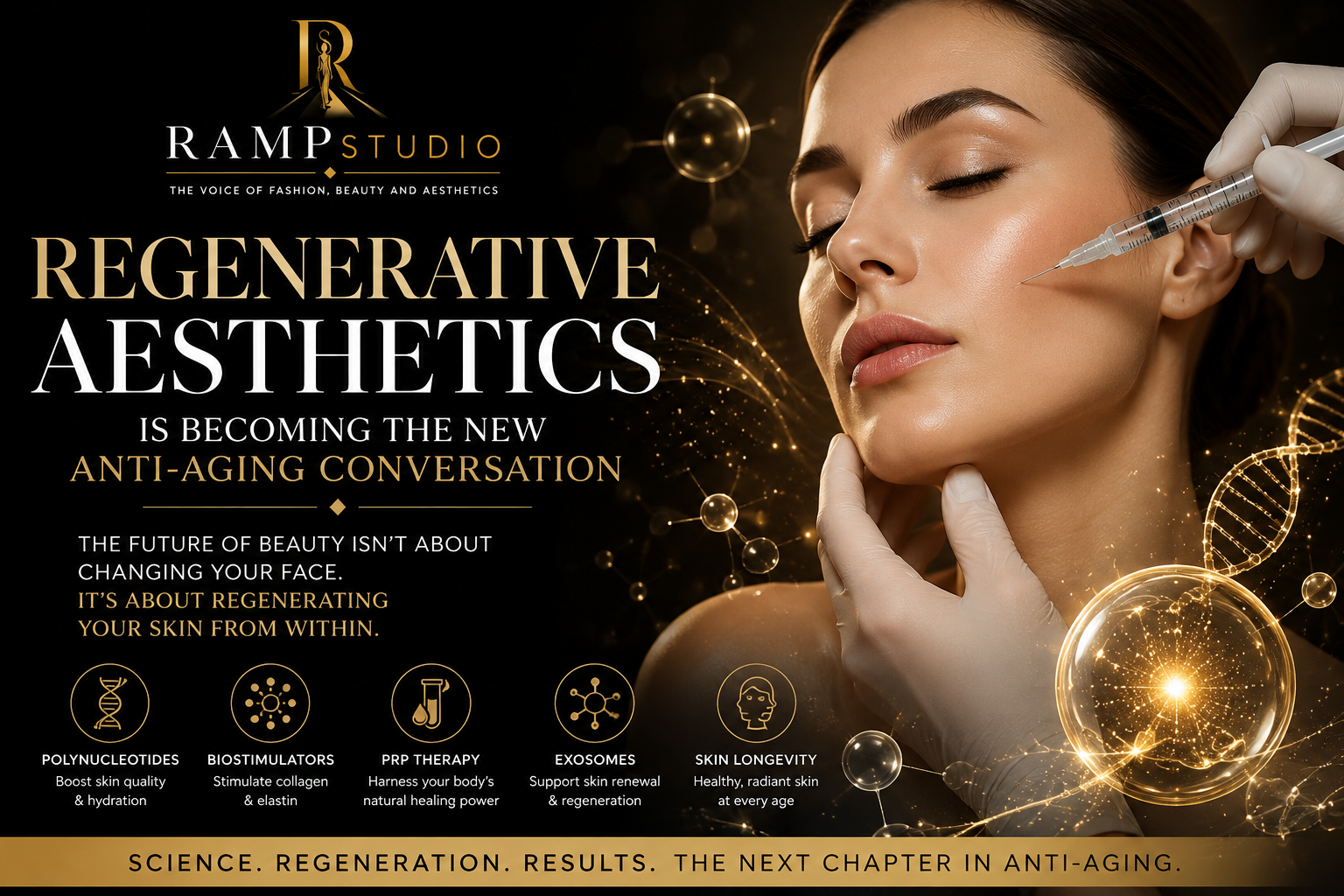
Regenerative aesthetics is emerging as one of the most talked-about directions in aesthetic medicine in 2026. Instead of focusing primarily on adding volume or dramatically changing facial features, the approach emphasizes improving skin quality, collagen support, hydration and natural-looking results. Treatments and technologies discussed under the regenerative-aesthetics umbrella include polynucleotides, biostimulators, platelet-rich plasma (PRP), certain skin boosters and emerging regenerative technologies. Recent aesthetics coverage from Vogue and Marie Claire reflects the industry’s growing interest in regenerative and prevention-focused treatments. For consumers, however, “regenerative” should not automatically be interpreted as “proven” or “risk-free.” Different treatments have very different levels of clinical evidence, regulatory status and appropriate uses.
What Is Regenerative Aesthetics?
Regenerative aesthetics is a broad term used for aesthetic approaches intended to support or stimulate biological processes involved in skin quality and tissue repair. Rather than simply correcting a visible feature, the goal may be to encourage processes associated with collagen production, skin resilience, hydration or tissue quality. This is part of a wider change in aesthetic medicine. Recent 2026 trend coverage describes a movement away from dramatic correction toward personalized, preventative and regenerative approaches.
In simple terms:
Traditional approach: Change or correct the appearance.
Regenerative approach: Focus more on supporting skin quality and the body’s biological processes.
The two approaches are not mutually exclusive. Many modern treatment plans combine different techniques according to a patient’s individual needs.
Why Is Regenerative Aesthetics Trending in 2026?
One major reason is changing consumer expectations.
Many people no longer want an obviously “done” appearance. Instead, they are looking for skin that appears healthy, refreshed and natural. A recent Vogue aesthetics report describes the industry’s movement toward regenerative treatments, advanced injectables and customized combinations of technologies. Market research also indicates growing interest in bioregenerative aesthetic injectables. Grand View Research estimates the global market for bioregenerative aesthetic injectables at approximately $1.7 billion in 2026, although market forecasts should not be confused with clinical evidence of treatment effectiveness. This shift is also connected to the broader skin longevity conversation.
Instead of asking only:
“How can I look younger?”
Consumers are increasingly asking:
“How can I maintain healthier-looking skin for longer?”
That distinction is helping reshape the language of modern aesthetics.
The Rise of Skin Quality Over Facial Transformation
One of the most important changes in aesthetic medicine is the growing emphasis on skin quality.
Skin quality can refer to characteristics such as:
- Hydration
- Texture
- Elasticity
- Smoothness
- Even-looking tone
- Fine lines
- Overall skin appearance
This doesn’t mean volume-based treatments or neuromodulators are disappearing. Rather, regenerative approaches are adding another dimension to aesthetic treatment planning.
The objective is often a more gradual and subtle improvement rather than an immediate transformation.
Polynucleotides Are One of the Biggest Regenerative-Aesthetics Trends
Polynucleotides have become one of the most frequently discussed treatments in regenerative aesthetics. They are made from purified DNA fragments and are used in aesthetic medicine in various protocols intended to support skin quality. Their popularity is linked to the broader movement toward biostimulation and natural-looking rejuvenation. Current aesthetics coverage identifies polynucleotides as one of the regenerative treatments attracting significant attention in 2026. However, consumers should avoid assuming that every claim made about polynucleotides has been conclusively established. The evidence base varies by product, indication and treatment protocol, so consultation with an appropriately qualified medical professional is important.
Biostimulators Are Changing the Anti-Aging Conversation
Another major category is collagen-stimulating biostimulators.
Rather than functioning solely as traditional fillers, some biostimulatory products are designed to encourage the body’s own collagen-production processes. For example, Sculptra is based on poly-L-lactic acid (PLLA) and is used in aesthetic medicine as a collagen-stimulating treatment. Recent reporting on its 2026 launch in India describes the product as part of the country’s growing shift toward regenerative approaches and gradual, natural-looking results. The important distinction is that these treatments should not all be grouped together. Different biostimulators have different materials, mechanisms, indications, evidence and regulatory approvals.
PRP Remains Part of the Regenerative-Aesthetics Conversation
Platelet-rich plasma, commonly called PRP, has also been investigated and used in various dermatological and aesthetic applications. PRP uses a patient’s own blood, which is processed to concentrate platelets before being used in a treatment protocol. The concept behind PRP is connected to the biological activity of platelets and growth factors. However, evidence can vary considerably depending on the condition being treated and the specific protocol. This is why patients should ask a practitioner about the evidence supporting the particular procedure rather than relying solely on the word “regenerative.”
What About Exosomes?
Exosomes are another major topic in the regenerative beauty conversation.
They are tiny extracellular vesicles involved in cell-to-cell communication and have attracted considerable interest in dermatology and aesthetic research. Some studies have explored potential applications involving inflammation, wound healing, collagen and skin regeneration. However, clinical evidence and regulatory status remain important considerations.
A critical safety point
In the United States, the FDA states that there are currently no FDA-approved exosome products and warns consumers about unapproved regenerative-medicine products marketed for various uses. That doesn’t mean research into exosomes should be ignored. It means consumers should distinguish between promising research, cosmetic marketing and established medical evidence.
Regenerative Aesthetics vs Traditional Fillers
The two approaches serve different purposes.
| Regenerative-focused approach | Traditional filler approach |
|---|---|
| Often focuses on skin quality | Primarily adds volume or contour |
| May aim for gradual improvement | Can produce more immediate structural change |
| Often associated with collagen stimulation | Uses a gel or material to restore/add volume |
| Can be used as part of preventative strategies | Commonly used for contouring and volume loss |
| Results depend on treatment and individual response | Results depend on product, placement and anatomy |
This doesn’t mean one is better than the other.
A qualified practitioner may recommend one treatment—or a combination—depending on the patient’s anatomy, concerns, medical history and desired outcome.
Why “Natural Results” Matter More in 2026
The growing popularity of regenerative aesthetics is closely connected to another major trend: natural-looking results.
A 2026 review of aesthetic-medicine trends from Ribera Salud describes increasing demand for personalized, less invasive approaches that preserve individual identity rather than creating dramatic changes. This reflects a broader change in beauty culture.
Instead of completely changing facial proportions, some patients want to:
- Improve skin texture
- Restore subtle volume
- Support collagen
- Improve hydration
- Reduce the appearance of fine lines
- Look less tired
- Maintain their existing facial identity
The goal is increasingly enhancement rather than transformation.
Is Regenerative Aesthetics Really Anti-Aging?
The term “anti-aging” can be misleading.
No aesthetic treatment can stop the biological aging process.
A more accurate description is skin rejuvenation or skin-quality improvement.
Healthy aging involves multiple factors, including genetics, UV exposure, lifestyle, hormones and natural changes in collagen and elastin. Dermatologists continue to recommend fundamentals such as sun protection and appropriate skincare. The American Academy of Dermatology also recognizes retinoids/retinol as useful options for certain concerns including fine lines, wrinkles and uneven pigmentation. Regenerative treatments should therefore be viewed as one component of aesthetic care, not a replacement for everyday skin health.
The Importance of Skin Longevity
The phrase “skin longevity” is becoming increasingly common in beauty and aesthetics. Rather than waiting until visible signs of aging become prominent, longevity-focused skincare emphasizes maintaining skin health over time. Current 2026 beauty coverage identifies longevity and resilient, healthy-looking skin as major themes.
This could mean combining:
- Daily sunscreen
- Evidence-based skincare
- Healthy lifestyle habits
- Preventative dermatology
- Appropriate aesthetic procedures
- Regular professional skin assessments
The idea is less about chasing a permanently youthful appearance and more about supporting healthy-looking skin throughout adulthood.
Are Regenerative Aesthetic Treatments Safe?
Safety depends on the specific treatment, product, practitioner and patient.
“Regenerative” is not a guarantee of safety.
Potential complications from injectable or procedural treatments can include swelling, bruising, infection, inflammation, allergic reactions and other procedure-specific risks. Some emerging products also have limited long-term evidence.
For this reason, patients should choose an appropriately qualified medical professional and ask:
- What exactly is being injected or applied?
- Is the product authorized for this use in my country?
- What evidence supports the treatment?
- What are the known risks?
- How many treatments are typically required?
- What results are realistic?
- What happens if a complication occurs?
These questions are particularly important for newer regenerative products.
What the Future of Regenerative Aesthetics Could Look Like
The direction of the industry suggests that regenerative aesthetics will continue developing alongside AI-assisted skin analysis, personalized treatment planning, advanced injectables and energy-based technologies.
The next stage may not be about finding one “miracle” treatment. Instead, the focus is likely to be on combining different technologies and procedures in carefully personalized protocols. Recent Vogue coverage of emerging aesthetic treatments similarly points toward treatment stacking and increasingly customized approaches. The result could be a future where aesthetic medicine focuses less on changing someone’s face and more on maintaining skin quality and facial harmony over time.
Frequently Asked Questions
What is regenerative aesthetics?
Regenerative aesthetics is a broad term for aesthetic treatments that aim to support biological processes associated with skin quality, collagen, tissue repair or rejuvenation. The category includes different treatments with varying levels of evidence.
What are the most talked-about regenerative aesthetic treatments in 2026?
Polynucleotides, biostimulators, PRP and emerging exosome-related technologies are among the treatments receiving significant attention in 2026.
Are polynucleotides the same as dermal fillers?
No. Polynucleotide treatments and dermal fillers are different categories of treatment. Traditional dermal fillers are commonly used to restore or add volume, while polynucleotides are marketed and used in some aesthetic settings with a focus on skin-quality and regenerative effects.
Are regenerative treatments better than Botox or fillers?
Not necessarily. They have different purposes. Neuromodulators, fillers, biostimulators and skin-quality treatments can address different aesthetic concerns. A qualified practitioner can determine which approach is appropriate.
What are exosomes used for in aesthetics?
Exosomes are being investigated and marketed for applications involving skin repair, inflammation and rejuvenation. However, evidence and regulatory status vary, and consumers should be especially careful about unapproved products. The FDA states that there are currently no FDA-approved exosome products in the United States.
Do regenerative treatments permanently stop skin aging?
No. Aging is a natural biological process. Regenerative or rejuvenating treatments may improve certain aspects of appearance, but they cannot permanently stop aging.
Can skincare still be important if someone has regenerative treatments?
Absolutely. Daily sun protection and an appropriate skincare routine remain fundamental. The American Academy of Dermatology recommends evidence-based approaches such as sun protection and notes that retinoids can help with certain signs of skin aging.
How should someone choose a regenerative aesthetic treatment?
Start with a consultation with an appropriately qualified medical professional. Ask about the exact product or procedure, evidence, regulatory status, expected results, risks, downtime and alternatives.
Final Thoughts
Regenerative aesthetics is changing the way the beauty industry talks about aging.
The focus is moving beyond simply filling lines or adding volume toward skin quality, collagen support, personalization and natural-looking results.
Polynucleotides, biostimulators, PRP and other emerging technologies are contributing to this conversation, but they should not all be treated as equally proven or regulated.
The smartest approach to aesthetic medicine in 2026 is not necessarily to pursue the newest treatment. It is to understand what the treatment is, what evidence supports it, who should perform it and whether it is appropriate for the individual.
The future of anti-aging may ultimately be less about trying to look younger—and more about maintaining healthy-looking skin while preserving what makes each face unique.
Sources & Further Reading
- Vogue — Emerging Aesthetic Treatment Trends for 2026
- Vogue — 2026’s Biggest Skincare Trends
- Marie Claire — Aesthetic Treatments Trending in 2026
- American Academy of Dermatology — Anti-Aging Skin Care
- American Academy of Dermatology — Retinoid or Retinol?
- U.S. FDA — Consumer Alert on Regenerative Medicine Products and Exosomes
- U.S. FDA — 2026 Safety Warning on Unapproved Cell and Tissue Products
Views: 1